The material footprints of finance in a low growth era- a panel regression and comparative study of affluent nations.
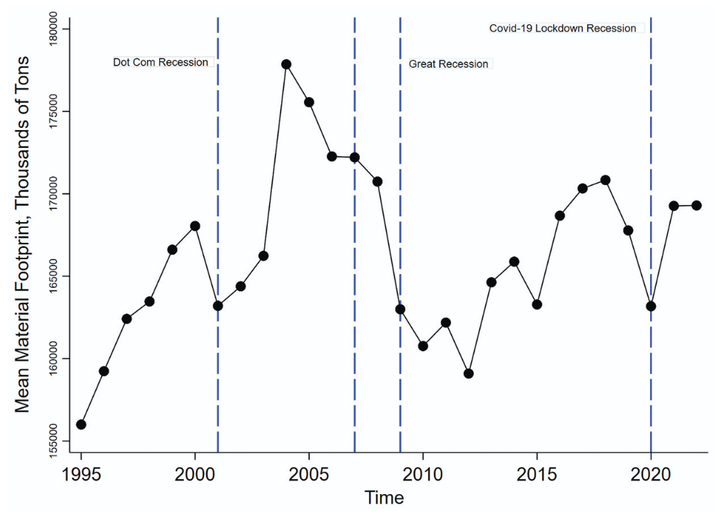 Average material footprint of nations over time.
Abstract
As human societies continue on a growth-dependent path, there is anxiety that rising demand for minerals and materials will increase pressure on global and regional earth systems, especially in the extractive economies of global South nations. Additionally, many scholars and international organizations have raised concern that, in affluent nations, current rates of aggregate raw material consumption are presently unsustainable. These concerns have long been articulated by environmental social scientists, such as those drawing on political-economic approaches that focus on production, growth and environmental change. However, the affluent world is, increasingly, marred by understudied dynamics associated with slow-growth and financialization. This study examines the relationships between the growing financial turn and the material footprint of nations, a common measure of the net environmental requirements to sustain a population’s consumption practices. Findings suggest that financialization aids in upholding unsustainable consumption patterns in affluent nations. Additionally, high consuming nations show comparatively lower rates of growth and higher rates of financialization relative to low consuming nations in the sample. Our findings point to the reality that additional theorizing is required to properly characterize new forms of, and linkages between, unsustainable economic inequality, exploitation and intensified environmental withdrawals in the world’s richest nations.